The month in review – October

1. Latest news

Party conferences, meeting MPs, advisers, officials and fellow organisations to make the business case for climate and nature action, with our Green Policy Review at the heart of those conversations. Energy bills dominated the policy conversation, with every party now putting forward an offer on energy costs, and water reform featured at every conference. You can read our full reflections, and what comes next, in our blog.

The Chancellor, John Healey, delivered his first Autumn Budget on 28 October. Our Executive Director, Rachel Solomon Williams, welcomed measures to ease energy costs, including removing hydrogen levy costs from electricity bills, and the restated net zero commitment, but warned the Budget fell short of the scale of the climate and nature challenge. We urge the government to move all policy costs from electricity bills to general taxation at next year’s Spending Review, and to protect investor confidence in heat pumps as Boiler Upgrade Scheme budgets shrink. The Aldersgate Group had produced a briefing for members on the key announcements. Register your interest here.

Ahead of COP31 in Antalya, Türkiye, we are delighted to be hosting The UK’s ambition for COP31 with Standard Life: an exclusive evening with the Rt Hon Miatta Fahnbulleh MP, Secretary of State for Energy Security and Net Zero, in conversation with Lord Adair Turner, co-Chair of the Energy Transitions Commission. The discussion will explore how the UK can strengthen its international climate leadership while delivering growth, energy security and industrial competitiveness at home.

arrows

2. Policy update

Net Zero Council

On 16 October, Rachel updated the Net Zero Council’s Sector Transition Plan Working Group, chaired by Chris Skidmore, on next steps for the Council’s work on cross-cutting barriers to decarbonisation, a workstream the Aldersgate Group is now leading.

Electricity costs and electrification

Ahead of the Budget, we continued to call for lower electricity costs, an electrification strategy and the protection of existing electrification funding. As part of this, we fed members’ views into the E3G-convened UK Electricity Bills Taskforce report, Lowering Great Britain’s electricity bills – recommendations for government.

We also signed an industry letter, led by Electrify Britain, urging the government to protect Warm Homes Plan funding in the Budget, after reports that some of it could be reallocated to defence – a move that would undermine progress on electrifying heat in homes.

As the Energy Independence Bill progresses through Parliament, we have been briefing parliamentarians across parties on affordability, electrification, community benefits from renewables, and climate and nature safeguards. In particular, we are calling for a national electrification plan that aligns government policy and funding to make electrification cheaper and easier for businesses and households to adopt – an ask we will continue to make to all parties.

Transport

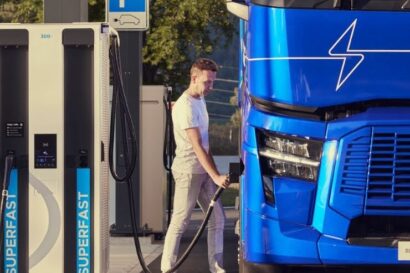
On 22 October, we launched our new report with the Renewable Energy Association (REA), Ready to Move: a framework for decarbonising UK HGVs, at Fleete’s EV charging hub at the Port of Tilbury. Richard Bruce CBE (International Council on Clean Transportation) and Mark Constable (REA) set the scene, followed by a whole-value-chain panel with Yuan Cao Zhang (KPMG), Chris Morrison (Fleete), Jo Bradley (Nestlé) and Lamech Solomon (Logistics UK).

The report’s central finding is that HGV decarbonisation is an energy problem, not a transport problem. Electric trucks are already in operation, but grid connections, electricity costs and financing risk are holding back wider adoption. The report calls for a clear long-term policy framework, finance that reduces risk, and infrastructure planned ahead of demand. We will be building on this work in the coming months.

Earlier in the month, Beth spoke on the opening panel at Shifting Gears, hosted by Creative Zero, Netflix and the BFI to accelerate the use of zero-emission vans and trucks in film and TV productions from 2027. Drawing on our HGV research, she set out the need for clear long-term policy signals, measures to close the cost gap with diesel and a strategy for charging infrastructure. This links to our wider project on decarbonising the creative industries.

Industrial decarbonisation

Beth gave the opening presentation at a workshop on public understanding of CCUS at the Carbon Capture and Storage Association’s annual conference, CCUS 2026: From Ambition to Delivery. Industry, policymakers and communications experts discussed how to make the case for CCUS more effectively, from its role in reindustrialisation, jobs and skills to costs for consumers, pipeline safety and messaging across the political spectrum. The CCSA will publish a short report on the workshop’s conclusions.

Water

On 14 October, we presented The Business Case for a National Water Framework to the Greater Manchester Combined Authority’s Strategic Infrastructure Board. GMCA Deputy Mayor Paul Dennett welcomed the report’s framing, highlighting how closely it aligns with the GMCA’s ambition for a more systematic approach to water resources and its case for greater devolved powers over water infrastructure planning.

On 28 October, we were delighted to bring together members, policymakers and partners for our flagship water event, Business, infrastructure and the future of water: navigating reform, kindly hosted by Pinsent Masons. It was a brilliant discussion, testing the report’s recommendations against the policy landscape as it stands, and it was great to see such energy and engagement in the room. Our warm thanks go to Pinsent Masons for hosting us so generously; to Dame Helen Ghosh (Chair, Office for Environmental Protection) for an insightful keynote; to Nick Molho (Aviva) for expertly chairing the panel; and to our panellists Julia Buckley MP, Iain Smedley (Barclays), Gordon McCreath (Pinsent Masons) and David Hill (Defra) for such a candid and constructive conversation. Thank you too to everyone who joined us.

Climate adaptation

We submitted written evidence to the Environmental Audit Committee’s inquiry into UK climate adaptation, arguing that adaptation is a prerequisite for growth and that the UK faces a preparedness gap. We called for clearer local and national plans to manage climate risk, so that businesses and investors can act with confidence.

Our new project on how national policy can unlock investment in place-based adaptation is now under way, looking at how climate risks could affect three growth areas across England. Our final report is due in the first quarter of 2027.

Circular economy

We met Defra’s circular economy team to continue to push for progress on the Circular Economy Growth Strategy.

Enabling private sector action on nature

On 13 October, we met the Office for National Statistics to discuss the Natural Capital Accounts: their scope and direction of travel, how they relate to HM Treasury’s accounting frameworks and the Green Book, and the differing ways nature is valued across Whitehall.

Net Zero and Nature Positive case studies

This month we published the first of our Net Zero and Nature Positive case studies, on Nestlé UK & Ireland’s Regenerative Milk Plan, delivered in partnership with First Milk. It examines the benefits of supply chain engagement and payments for environmental outcomes on dairy farms in Cumbria and Ayrshire. More case studies are in development.

3. External News

WWF and ScottishPower – Better Homes, Lower Bills

Members WWF and ScottishPower have published Better Homes, Lower Bills, produced with Frontier Economics. The report finds that investing an extra £1.5 billion a year in energy efficiency and low-carbon heating for fuel-poor households could significantly cut bills and emissions and improve living conditions across the UK. It recommends more funding for home energy upgrades, moving legacy renewable policy costs from electricity bills into general taxation, and a Warm Homes Agency to support local delivery and provide trusted advice.

The Wildlife Trusts – Route Map to Recovery: Fixing Nature in the UK

Published ahead of the UN biodiversity conference, COP17, The Wildlife Trusts’ new report, Route Map to Recovery: Fixing Nature in the UK, warns that the UK is off track to halt and reverse nature loss by 2030 – on course to meet just three of the Global Biodiversity Framework’s 23 targets – putting both nature recovery and national security at risk. It calls for nature to be treated as essential national infrastructure, for the commitment to protect 30% of land and sea to deliver real improvements on the ground, and for every level of government to be properly resourced to deliver nature recovery.

UKAS – industry call for an EU–UK mutual recognition agreement on conformity assessment

Member UKAS (the United Kingdom Accreditation Service) has welcomed an industry call to action, convened by UKAS and backed by business associations across Europe, for an EU–UK mutual recognition agreement on conformity assessment. Building on the 2025 EU–UK Common Understanding, it argues that duplicated conformity assessment, where products must be tested and certified separately for each market, is creating barriers to trade, and that mutual recognition would streamline market access, give manufacturers long-term certainty and strengthen supply chains on both sides. Read the UKAS announcement here.

Nature Finance UK 2026 (Thursday 12 November, QEII Centre, Westminster)

Nature Finance UK 2026 brings together leaders from business, finance, government and the environment sector to explore practical ways to scale investment in nature recovery, with corporate seminars on nature-related risks and opportunities alongside plenaries, panels and networking.

Innovation Zero – Electrifying the Economy Conference (Monday 23 November, 1 Basinghall Avenue, London)

The Powering Up Business Poll found that 90% of business leaders plan to be largely electric by 2035, yet grid constraints, high energy costs and skills gaps still stand in the way. The Electrifying the Economy Conference brings together the businesses, energy system operators, policymakers and investors driving UK electrification to tackle these barriers head-on. Speakers include Laura Sandys CBE (Ofgem), Tim Lord (HSBC UK), Julia Beck (UK Export Finance), Sam Mathew (Microsoft), Nikki Hunter (Network Rail) and Miles Durrant (Royal Mail), with ABB and Schneider Electric as key partners. Our Executive Director, Rachel Solomon Williams, will moderate the panel “Accelerating Deployment Through Collaboration”.

envecon 2027 (Friday 5 March 2027, The Royal Society, London)

Tickets are now available for envecon 2027, the annual applied environmental economics conference run by the UK Network for Environmental Economists (UKNEE), now in its 25th year. Dr James Richardson, Chief Analyst at the Climate Change Committee, will give the keynote address, and the full programme will be announced in January. The call for papers is open until 16 November for papers, posters and panels that apply environmental economics to policy, business and society.

4. Join us

The Aldersgate Group’s cross-economy membership includes some of the largest businesses in the UK, non-governmental organisations (NGOs), public sector bodies, trade associations and influential individuals, including parliamentarians from across the political spectrum.